The Albums of my Life: LIVE AT THE ACROPOLIS by Yanni

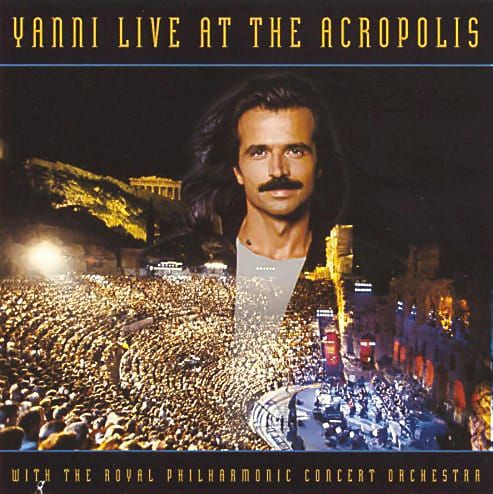
There's an album that came out in 1994. It's a live album, made at one of the more famous concerts of that decade. And this live concert album is one of my favorite albums of all time. Because of this album, this very concert is on my short list of possible answers to the question, "If you could attend one music concert in history, which would it be?" This concert was energetic and fun and beautiful and even a bit moving.
I'm speaking of Yanni and Live at the Acropolis.
No, I am not joking. This album is, as the kids say these days, a banger, and I say so proudly with no hint of apology intended.
Back when I was in college, I discovered what was called "New Age Music". Often melodic and lyrical in a calming and meditative way, this music formed the soundtrack of many a night of studying. It's a genre that sprawls all over the place to such a degree that it's not even really clear what characteristics it all shares enough to be called a "genre" in the first place. It can be acoustic, or electronic, or both. It can involve western instruments, or eastern ones, or instruments from African and South American ethnicities. It can be based in Western modes and tonalities, or Eastern ones. It can be based in melody, or it can be based on atmospherics and mood. It can even be less music and more soundscape. It can be geared toward a "New Age" spirituality, or it can be based on old mythology and stories. It can also be totally abstract. And since New Age music can be so very many things, I suppose that's why it often seems like it's not much of anything at all, until one listens to a lot of it. There is a public radio program called Echoes that focuses partially on New Age music, and that show has been around since 1989, so there's most definitely a "there" there.
Yanni, born Yiannis Chryssomallis in Kalamata, Greece in 1954, is one of the more familiar names in this particular musicscape. Even though he really hit his stride in the early 1990s, Yanni paid his dues as a musician, with his first professional music activity coming as a member of a Minneapolis rock band during his college years in 1977. He began recording his own music a few years later, and in the late 80s his music–a blend of New Age, soft rock, and contemporary instrumental–started to gain steam. The big event was to come in September 1993, when he gave a live performance of his best music to date at the Odeon of Herodes Atticus at the Acropolis in Athens. This performance was filmed and broadcast all over the world, and it was a huge hit; for a number of years afterward if you were channel-flipping at home and you found Yanni's Acropolis concert playing on your local public teevee station, you knew it was pledge time. Yanni was famously involved with Actress Linda Evans at the time, and the camera frequently cut to her, showing her loving admiration for Yanni as he led his band and a full orchestra.
All of this is pretty easy to mock, I suppose. Yanni's music isn't particularly deep, by any means. But it's deeper than it seems at first listen, and the man has an incredible knack for pure melody and for composing pieces with drive. And that's what makes the resulting Live at the Acropolis album such a satisfying listen: this is music that just wants to please the listener, and that it does, with a kind of energy that many live concert albums wish they could emulate. The proceedings start with a track called "Santorini", which opens with an infectious rhythm that leads to a melody in the horns that is punctuated by these big blasts in the basses and low brass. The whole thing demands to be played at a high volume. After the introduction, a fast and lengthy melody takes over in the strings. "Santorini" whips along with tons of kinetic energy before it culminates in a chord that feels like a wave breaking on a giant rock, and then we're into a slow and lyrical middle section. "Santorini" feels like an overture to the night to come.
The rest of the album has a lot of variation throughout. Some of the tracks are openly the kind of "mystical synth" stuff you'd expect from a New Age artist, others mostly eschew the synth and electronica for simple analog beauty ("Until the Last Moment" is particularly effective here), and it all culminates in a wonderful track called "Reflections of Passion"--one of Yanni's greatest hits, actually--that I have to admit appealed to me greatly nearly 30 years ago when the Then-Fiancee and I were discussing music for our wedding reception. (I don't know is the album preserves the concert's set list in order; I assume that it does not, actually. I haven't watched the complete concert since it was on PBS in the '90s.) Finally, I note that Live at the Acropolis is a great album to have on while you're doing stuff. Not that I suggest it as passive background music, but as loud, active music that enhances what you're doing. Live at the Acropolis is great driving music, and it's also great to have on the earbuds while you're doing street photography someplace.
Is Live at the Acropolis great music? Honestly, I don't know that it is. But it's awfully good music-making, and that matters. The album is so well put-together, and so well presented and performed, and it sounds so good, that I have to admit that this particular concert is a frequent answer of mine to the question "If you could go back in time to attend one concert in history, what would it be?" Sometimes, there's a kind of magic that happens at a live performance that makes the resulting performance somehow transcend the material that's being performed. Live at the Acropolis brings me pleasure and makes me happy every time I listen to it. I will never not love this album and that's why it's one of the albums of my life.
Thanks for reading! If you've come this far, I hope you'll consider subscribing.
Exeunt,
--K.
For more content by me, including links to all my social media, please visit my website, ForgottenStars.net.